Category
AI Testing & Code Quality
AI testing and code quality tools focus on keeping code correct and maintainable: generating and improving tests, enforcing standards, catching risky changes and reviewing code against your team’s rules. As more code is written by AI, independent quality checks matter more, not less.
How to choose:
- Coverage of your workflow: check whether the tool works in the IDE, in pull requests, in the CLI or in CI — ideally where problems are cheapest to fix.
- Context: tools that index your whole codebase and its history give more relevant findings than ones that only see a diff.
- Configurable standards: look for rules you can define and tune, so findings reflect your conventions rather than generic advice.
- Deployment and data: SaaS, single-tenant or self-hosted options, and how code is retained, matter for regulated teams.
Our reviews: Qodo, SonarQube, Codacy, DeepSource, Diffblue Cover.
AI Testing & Code Quality reviews at a glance
Listed alphabetically: this is not a ranking. Our ranked picks are in the Top 10. “Best for” and strengths come from each review and its cited sources.
Codacy
Best for: Teams on GitHub, GitLab Cloud or Bitbucket Cloud that want deterministic quality and security gates with AI review on top.
- A free Developer tier that brings AI Guardrails, security scanning and quality scanning into VS Code, Cursor, Windsurf and JetBrains IDEs.
- Covers more than 40 languages, with tools such as ESLint, PMD, Pylint, Trivy and Opengrep, plus infrastructure-as-code scanning.
- Quality gates, coverage and security findings sit next to AI review, so AI suggestions are grounded in deterministic analysis.
DeepSource
Best for: Teams that want one quality and security gate on every pull request, across GitHub, GitLab, Bitbucket or Azure DevOps.
- Static analysis with more than 5,000 rules runs before the AI agent, which DeepSource says produces fewer false positives.
- A broad platform: SAST, secrets detection, dependency scanning with reachability, IaC checks, coverage, license compliance and OWASP and SANS reports.
- Supports GitHub, GitLab, Bitbucket and Azure DevOps with no CI configuration.
Diffblue Cover
Best for: Enterprise Java teams that need regression test coverage at scale without sending code to an LLM provider.
- A reinforcement-learning engine that needs no external AI provider and can run behind your firewall.
- Built-in validation.
- Scales from a single method in IntelliJ to whole projects through the CLI and CI.
Qodo
Best for: Organisations enforcing review standards across many repos and Git providers, including on-prem.
- Works with GitHub, GitLab, Bitbucket, Azure DevOps and Gerrit.
- A rules system that can mine standards from your PR history and enforce them in every review.
- Deployment ranges from multi-tenant SaaS to single-tenant, on-premises and air-gapped (Enterprise).
SonarQube
Best for: Teams that want an enforced, auditable quality and security baseline for both human- and AI-written code.
- Deterministic analysis across 30 to 40+ languages, depending on edition, with quality gates that can fail CI.
- Free entry points: SonarQube for IDE, the open-source Community Build, SonarQube Cloud's free plan and an MCP server.
- AI CodeFix in the web interface and in VS Code and IntelliJ, with a self-hosted LLM option for Server.
All 5 AI Testing & Code Quality articles
-
 Review
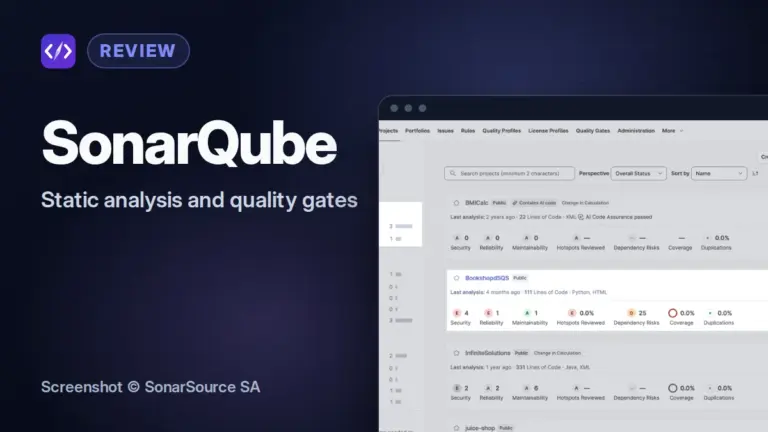
SonarQube Review (2026): Static Analysis as a Check on AI-Written Code
Read review →: SonarQube Review (2026): Static Analysis as a Check on AI-Written CodeSonarQube in October 2026: static analysis and quality gates plus AI CodeFix, AI Code Assurance, an MCP server and new agents, with plans from free.
-
 Review
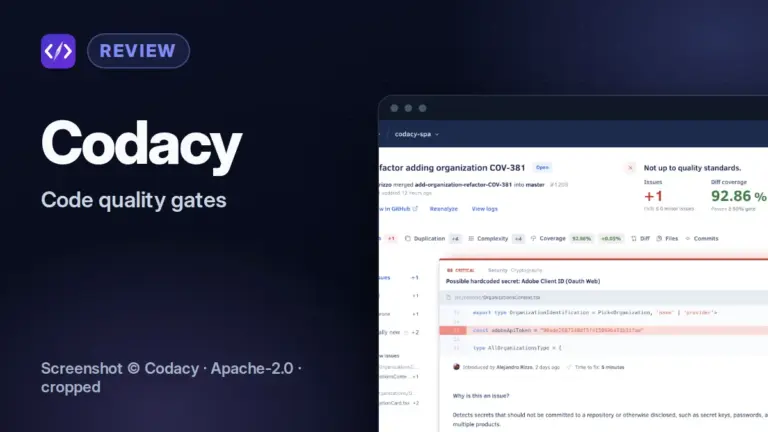
Codacy Review (2026): Code Quality Gates Meet AI Review and Guardrails
Read review →: Codacy Review (2026): Code Quality Gates Meet AI Review and GuardrailsCodacy in October 2026: static analysis, security scans, a GitHub AI Reviewer and IDE AI Guardrails, with a free tier and Team from $18/dev.
-
 Review
DeepSource Review (2026): Static Analysis Meets AI Code Review
Read review →: DeepSource Review (2026): Static Analysis Meets AI Code ReviewDeepSource in 2026: hybrid static analysis and AI review, Autofix, security scanning, Team pricing with metered AI credits, and its Harness acquisition.
-
 Review
Diffblue Cover Review (2026): Autonomous Java Unit Tests Without an LLM
Read review →: Diffblue Cover Review (2026): Autonomous Java Unit Tests Without an LLMDiffblue Cover in October 2026: on-prem Java unit test generation, editions and limits, and how it compares with Diffblue’s new LLM-based Testing Agent.
-
 Review
Qodo Review (2026): Is the Former Codium AI Worth It for Code Review?
Read review →: Qodo Review (2026): Is the Former Codium AI Worth It for Code Review?Qodo (formerly Codium) is now a code review and governance platform. A research-based look at Qodo 3.0, credit pricing, deployment options and limits.