Disclosure: CodeToolPilot may earn a commission if you buy through links on this page, at no extra cost to you. How we make money.
This is an editorial research buyer’s guide based on official documentation, pricing pages and the sources listed below — how we review. Prices and plans change often; confirm on the vendor’s site.
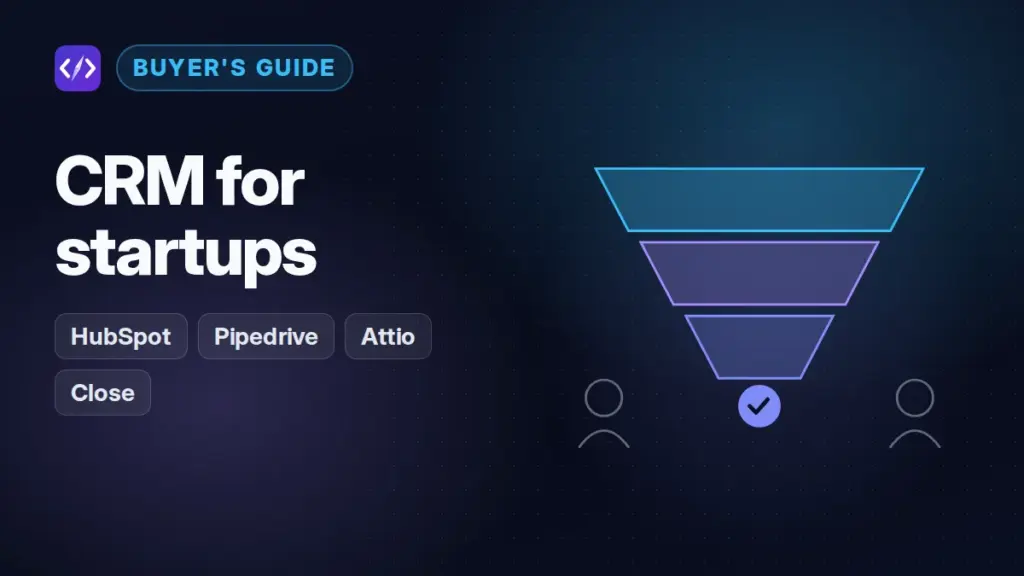
Most startups pick a CRM around the time a founder’s spreadsheet of leads stops working, usually when the first salesperson joins or investor and partner conversations start slipping through. The choice sticks. Contact data, deal history and automations pile up quickly, and migrating later is a project nobody wants. This guide is for technical founders and small teams choosing their first real CRM, or replacing one that has stopped fitting.
We compare six options with different philosophies: HubSpot’s free-to-enterprise platform, Pipedrive’s pipeline-first sales tool, Attio’s flexible data model, Close’s built-in calling and email, folk’s lightweight relationship CRM and Twenty, an open-source CRM you can self-host. The CRM is one part of a wider set of tools, and our guide to project management software for software teams covers how the rest of a small company’s stack fits together.
This is an editorial research article. It is based on each vendor’s official pricing pages, documentation and program terms, checked on October 17, 2026. We did not run our own benchmarks or measure performance. Prices are in USD, exclude tax unless stated otherwise, and change often, so confirm them before you buy.
Quick picks
- HubSpot — best for startups that want a free CRM now and marketing, sales and service tools on one platform later.
- Pipedrive — best for small sales teams that think in pipeline stages and want a simple, predictable per-seat price.
- Attio — best for technical teams that want a flexible data model, an API and an MCP server, with a usable free tier.
- Close — best for outbound-heavy teams that want calling, SMS and email built into the CRM.
- folk — best for founders managing relationships across LinkedIn, Gmail and WhatsApp rather than a formal sales process.
- Twenty — best for developers who want an open-source CRM they can self-host or extend in TypeScript.
How we chose
We did not lab-test these products. We reviewed public information against criteria that matter most to an early-stage company:
- Cost at small team sizes: what one to ten seats cost, whether there is a free tier, and which prices need an annual term.
- Time to value: whether a founder can set it up without a consultant or a required onboarding fee.
- Developer access: API, webhooks, MCP servers and documented limits, for teams that will connect the CRM to their own product.
- Room to grow: the features the next plan adds (automation, permissions, SSO) and how steeply prices rise.
- Startup programs: published discounts, with their eligibility rules and how long they last.
Our sources were each vendor’s pricing page, plan comparison tables, help documentation and published startup program terms.
The picks
HubSpot
HubSpot’s free CRM is often a startup’s first CRM because it costs nothing to start and plugs into a much larger platform. According to HubSpot’s pricing page, the free tier covers up to 2 users and 1,000 contacts, with no time limit. It includes deal pipelines, a meeting link, live chat, quotes, forms and up to 2,000 marketing email sends per month. Free assets carry HubSpot branding. Many older articles describe a far more generous free plan, so check the current limits.
Best for: teams that expect to add marketing automation, a help desk or a website on the same platform. Our full HubSpot CRM review covers the free tools and the seat model in detail.
Notable limits: costs rise steeply above Starter. Sales Hub Professional starts at $90 per seat per month on HubSpot’s pricing page and requires a one-time $1,500 onboarding fee. AI agents draw on monthly HubSpot Credits, which don’t roll over.
Starting price: Starter lists at $20 per seat per month. As of October 2026 HubSpot is offering new customers a limited-time price of $7 per seat per month with upfront annual payment, or $10 per seat on monthly billing. The page does not say what renewals cost. Eligible funded startups can get up to 90% off Professional or Enterprise in year one through HubSpot for Startups. HubSpot CRM pricing
Pipedrive
Pipedrive is a sales CRM built around a visual deal pipeline. All four plans are priced per seat. The entry Lite plan covers lead, deal and calendar management, AI report creation and Pipedrive’s meeting intelligence feature. Growth adds full email sync with tracking, automations and email sequences. Premium adds lead generation and routing through LeadBooster, scoring, contracts with e-signatures and finer permissions.
Best for: founder-led or small sales teams with a clear stage-based process that want a tool salespeople will actually keep up to date.
Notable limits: there is no free plan, only a 14-day trial. Marketing email (Campaigns), web visitor tracking and project features are paid add-ons on lower tiers. Pipedrive is a sales tool, not a marketing or support platform.
Starting price: Lite is $14 per seat per month billed annually ($168 a year) or $19 billed monthly. Pipedrive’s prices exclude VAT. See Pipedrive plans
Attio
Attio is a newer CRM built around a flexible data model. You define objects, attributes and relationships, and email and calendar sync keeps records up to date automatically. Its plan comparison lists API and webhook access, an App SDK, an MCP server, AI agents and workflow automation. Usage-based AI and automation features draw on seat credits and workspace credits.
Best for: technical teams that want to shape the CRM around their own data, such as product-led signups, investor pipelines or partnerships, and connect it to internal tools.
Notable limits: the free plan allows up to 3 seats, 3 objects and 50,000 records. Plus allows up to 10 seats and 5 objects. Features such as call intelligence, sequences and permission controls sit on Pro. Because the product is so flexible, someone has to design the data model, which can slow a team with no clear owner.
Starting price: Free; Plus is $35 per user per month billed annually or $44 monthly; Pro is $79 annually or $99 monthly. Attio’s startup program offers 80% off the annual Pro plan and credits in year one and 30% off in year two. It is limited to VC-backed companies incorporated less than 10 years ago that signed up within the last 90 days, for workspaces of up to 10 seats. Attio pricing
Close
Close is a sales CRM with calling, SMS, email and a shared inbox built in. Its AI sales agent, Chloe, runs on monthly AI credits. Each plan includes a per-user allowance (500 credits on Solo, 1,000 on Essentials), credits refresh monthly without rollover, and more can be bought.
Best for: outbound-heavy startups where reps make calls and send sequences all day and want activity logged without extra tools.
Notable limits: Solo is limited to 1 user and 10,000 leads, and neither Solo nor Essentials includes workflows. Automated workflows, the power dialer and bulk email start on Growth at $99 per user per month billed annually. Calling is billed on usage on top of seats.
Starting price: Solo is $9 per user per month billed annually or $19 monthly; Essentials is $35 annually or $49 monthly. A free trial is available without a credit card. Visit Close
folk
folk is a lightweight relationship CRM. It syncs email, calendar and WhatsApp, captures contacts through a LinkedIn extension, and adds enrichment, AI “magic fields” and email campaigns. It feels closer to a smart contact list than a sales system.
Best for: founders tracking investors, hires, partners and early customers in one place, and small agencies doing relationship-driven sales.
Notable limits: custom objects and deals, email sequences, dashboards and API access require Premium. The pricing page lists no free tier. Its FAQ says that after the two-week trial, folk blocks the account until you upgrade, though data is not deleted immediately.
Starting price: Standard is $24 per member per month billed annually or $30 monthly; Premium is $48 annually or $60 monthly. folk pricing
Twenty
Twenty is an open-source CRM. Its license file says the project is mostly licensed under AGPLv3, with some files under a commercial license and some packages under MIT. You can self-host it with Docker Compose or use Twenty’s managed cloud. Developers can extend it with an apps framework in TypeScript, and every cloud workspace includes a native MCP server.
Best for: developer-led teams that want to own their CRM data and infrastructure, or customize the CRM deeply in code.
Notable limits: self-hosting means you handle upgrades, backups and security yourself. SSO and row-level permissions need the Organization plan on cloud. The partner ecosystem is smaller than HubSpot’s or Pipedrive’s.
Starting price: Cloud Pro is $9 per user per month on yearly billing ($12 monthly), with a free trial that needs no credit card. Organization is $19 per user per month on yearly billing ($25 monthly). Enterprise starts at $50,000 a year. Self-hosting the open-source code has no license fee, but you pay for your own servers. Explore Twenty
Comparison table
| CRM | Free tier | Built around | Developer access | Watch out for |
|---|---|---|---|---|
| HubSpot | Yes: 2 users, 1,000 contacts | All-in-one marketing, sales and service platform | Public APIs with documented rate limits by tier | Steep jump to Professional, onboarding fees, credits |
| Pipedrive | No (14-day trial) | Visual sales pipeline | Integrations marketplace (500+ apps per Pipedrive) | Paid add-ons for marketing and lead capture |
| Attio | Yes: up to 3 seats | Flexible objects and relationships | API, webhooks, App SDK, MCP server | Seat caps on Free and Plus; credit-based AI |
| Close | No (free trial) | Calling, SMS and email for sales reps | API (API keys or OAuth), Zapier | Workflows only from Growth; usage-based calling |
| folk | No (2-week trial) | Relationship and contact management | API on Premium; MCP server listed | Deals and custom objects need Premium |
| Twenty | Self-host (open source) | Open-source, customizable CRM | Apps framework, APIs, webhooks, MCP | You run and secure self-hosted installs |
Pricing (as of October 2026)
| CRM | Entry paid plan | Next tier | Billing notes |
|---|---|---|---|
| HubSpot | Starter: $20/seat/month list; promo $7/seat/month (annual upfront) or $10 (monthly) for new customers | Sales Hub Professional from $90/seat/month + $1,500 one-time onboarding | Promo is limited-time; renewal price not stated. Starter includes 500 credits/month. |
| Pipedrive | Lite: $14/seat/month annual, $19 monthly | Growth: $24 annual, $34 monthly | Premium $49/$64; Ultimate $69/$89. VAT excluded. |
| Attio | Plus: $35/user/month annual, $44 monthly | Pro: $79 annual, $99 monthly | Free plan up to 3 seats. Enterprise is custom and billed annually. |
| Close | Solo: $9/user/month annual, $19 monthly (1 user) | Essentials: $35 annual, $49 monthly | Growth $99/$109; Scale $139/$149. Calling billed on usage. |
| folk | Standard: $24/member/month annual, $30 monthly | Premium: $48 annual, $60 monthly | Enterprise from $80/member/month billed yearly. |
| Twenty | Cloud Pro: $9/user/month yearly, $12 monthly | Organization: $19 yearly, $25 monthly | Enterprise from $50,000/year. Self-hosting has no license fee. |
Startup discounts can change the picture a lot in the first year. HubSpot and Attio tie theirs to funding, partner affiliation or account age, and the discount steps down over two (Attio) or three (HubSpot) years. Budget for list price after that.
Prices verified against each vendor’s official pricing page (listed under Sources). Plans, promotions and renewal prices change often — confirm on the vendor’s page before you buy.
How to choose
- If you have no budget and no salesperson yet: HubSpot’s free CRM or Attio’s free plan will hold a founder’s pipeline. HubSpot’s free tier is capped at 1,000 contacts and 2 users, so check whether you will outgrow it within months.
- If you are hiring your first salespeople: Pipedrive and Close are built for reps who live in the pipeline. Choose Close if calling and sequences are the job, and Pipedrive if stage management and forecasting matter more.
- If your CRM data comes from your product: Attio’s flexible objects and API, or Twenty’s open-source code, fit product-led companies that sync signups, workspaces and usage into the CRM.
- If marketing email matters as much as sales: a CRM with built-in marketing (HubSpot) saves an integration. If you plan to use a dedicated tool, see our roundup of email marketing software for SaaS.
- If you will connect many tools: check native integrations first. For gaps, an automation layer works. Our comparison of Zapier, Make and n8n explains the trade-offs, including self-hosting n8n.
- If support tickets need to reach the CRM: decide early whether support will live in the same platform. Our help desk software roundup covers which help desks integrate with which CRMs.
Whatever you choose, run a two-week trial with your real pipeline. Import a sample of contacts, rebuild one actual deal flow and connect your email before you commit to an annual plan.
Bottom line
There is no single best CRM for every startup. In our assessment, HubSpot is the safest default if you want a free start and expect to grow into marketing and service tools, as long as you budget for the jump to Professional. Pipedrive and Close are the practical choices for sales-led teams, Attio suits technical teams that want to shape their own data model, folk suits relationship-driven founders, and Twenty is the clear option if self-hosting and open source are requirements. Start with the lowest-priced plan that covers your real process, and read the renewal and startup-discount terms before signing an annual contract.
FAQ
Is HubSpot’s free CRM really free?
Yes, with limits. HubSpot’s pricing page lists the free tier at up to 2 users and 1,000 contacts, with no time limit, and free assets carry HubSpot branding. Free users can’t use HubSpot Credits, so credit-based AI agents need a paid seat.
Do startup discounts apply to every plan?
No. HubSpot for Startups pricing applies only to net-new Professional or Enterprise products and requires an annual commitment. Attio’s program applies to the annual Pro plan for workspaces of up to 10 seats. Each program has funding or affiliation requirements.
Can I self-host a CRM?
Of the tools here, Twenty publishes its code and documents self-hosting with Docker Compose. HubSpot, Pipedrive, Attio, Close and folk are sold as hosted services, and none of their pricing pages lists a self-hosted option.
Annual or monthly billing?
Annual billing is cheaper at every vendor here that publishes both rates. The saving ranges from under 10% to about half, depending on the vendor and plan. Until your team size and process are stable, monthly billing is often worth the premium.
Sources
- HubSpot: Smart CRM pricing
- HubSpot: Starter Customer Platform offer
- HubSpot: Sales Hub pricing
- HubSpot for Startups program
- Pipedrive pricing
- Attio pricing
- Attio startup program
- Close pricing
- folk pricing
- Twenty pricing
- Twenty license file on GitHub
- Twenty docs: Self-host
- HubSpot developer docs: API usage guidelines and limits
- HubSpot Knowledge Base: Understand HubSpot Credits and billing