Disclosure: CodeToolPilot may earn a commission if you buy through links on this page, at no extra cost to you. How we make money.
This is an editorial research comparison based on official documentation, pricing pages and the sources listed below — how we review. Prices and plans change often; confirm on the vendor’s site.
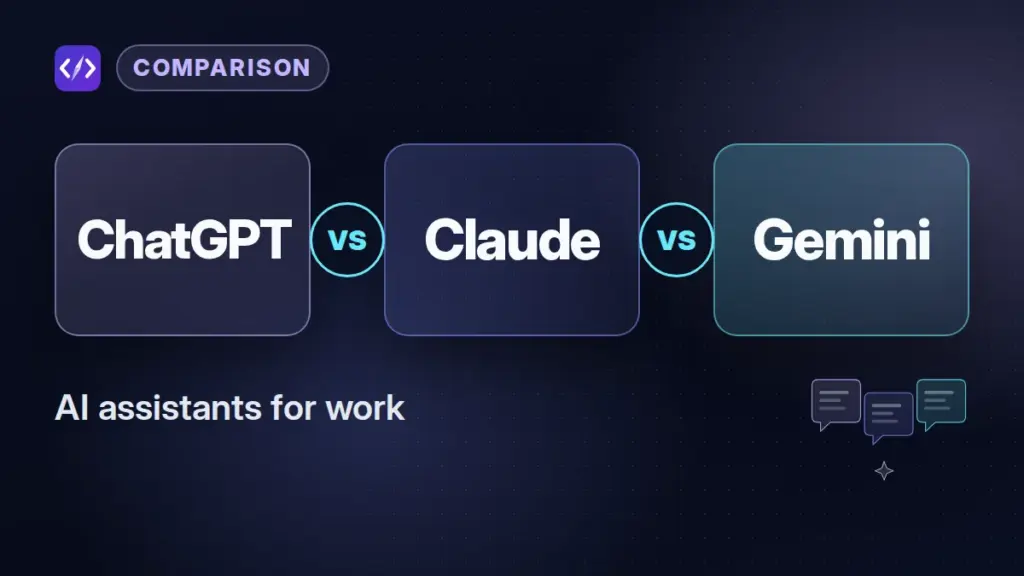
ChatGPT, Claude and Gemini are the three general-purpose AI assistants most technical teams end up choosing between. All three now sell a consumer subscription, a self-serve team plan and an enterprise contract. All three bundle more than chat: coding agents, file analysis, connectors to work apps and some form of agent that runs multi-step tasks. That makes the decision less about which chatbot “sounds smarter” and more about plans, usage limits, integrations and how each vendor treats your data.
This comparison is for developers, technical founders and small teams who want to pay for one assistant for work, or standardise a team on one. It sits inside our broader guide to AI productivity tools for developers and tech teams, which covers the rest of the stack around these assistants.
This is an editorial research article. It is based on each vendor’s official pricing pages, help centers, model documentation and privacy terms, all checked on October 17, 2026. We did not run our own benchmarks or quality tests, and we do not cite benchmark scores, because public leaderboards change weekly and rarely match a specific team’s work.
Quick verdict
There is no single winner for every team; the right pick depends on where your work already lives. In our assessment, ChatGPT is the broadest package, with the most consumer tiers, built-in image creation, Office and Sheets extensions, and Codex in every paid plan, but its Free and Go tiers may show ads, and its consumer plans train on your chats by default. Claude advertises a context window of up to 1M tokens (varying by model), level with Google AI Pro’s 1M, and includes Claude Code from the Pro plan up, but its Team plan lacks SCIM and audit logs, and its Enterprise plan bills all usage at API rates on top of the seat fee. Gemini is the natural choice for Google Workspace organisations, because Gemini is already part of Workspace business plans and covered by Workspace’s data terms. Its consumer plans, however, allow human review of chats unless you change settings.
- Pick ChatGPT if you want the widest feature set in one subscription and your team works in Microsoft Office or a mix of tools.
- Pick Claude if long documents, large codebases and coding agents matter most, and you can work within five-hour session limits and weekly caps.
- Pick Gemini if your company runs on Google Workspace, or you want a lower-priced individual tier bundled with storage.
At a glance
| Dimension | ChatGPT (OpenAI) | Claude (Anthropic) | Gemini (Google) |
|---|---|---|---|
| Main individual plan | Plus, $20/month | Pro, $20/month (or $17/month billed annually) | Google AI Pro, $19.99/month |
| Self-serve team plan | Business, from $20/user/month annually ($25 monthly), 2-seat minimum | Team, from $20/seat/month annually ($25 monthly), 2–150 seats | Gemini in Workspace Business plans, or Gemini Enterprise Business from $21/seat/month |
| Current flagship models (Oct 2026) | GPT-6 family (GPT-6 and GPT-6.1 Sol, Astra for Pro reasoning, Luna) | Fable 5.1, Opus 5.5, Sonnet 5.5, Haiku 5.5 | Gemini 4 Argon, 3.1 Pro, Flash |
| Advertised context | Plus: 54K (Instant) / 256K (reasoning); Pro: 128K / 400K | Up to 1M on paid plans, varies by model | 1M tokens on Google AI Pro |
| Coding agent included | Codex (limited on Free and Go) | Claude Code (Pro and above) | Jules and Google Antigravity (higher limits on Pro and Ultra) |
| Consumer chats used for training | Yes by default, opt-out available | Yes if the model-improvement setting is on (chosen at sign-up) | Yes while Keep Activity is on; human reviewers may read chats |
| Business data used for training | No, by default | No, by default | No, outside your domain without permission (Workspace) |
| SCIM and audit logs | Enterprise only | Enterprise only | Workspace admin tools; Gemini Enterprise Standard/Plus for advanced controls |
Plans and what each tier really includes
ChatGPT
OpenAI sells Free, Go, Plus and Pro for individuals, plus Business and Enterprise for organisations. Go is a low-cost tier whose price varies by country. OpenAI’s help center says “all purchases are in USD”, with local-currency billing in some countries, and the pricing page notes that Go “may include ads”. Plus costs $20 a month, billed monthly only. Pro now comes in three monthly-only tiers: Pro 100 ($100), Pro 200 ($200) and Pro 500 ($500). Only Pro 500 includes “Ultrafast” responses. OpenAI also says new Pro 200 subscriptions get a lower usage allowance than before, and eligible existing subscribers keep the old allowance only until October 29, 2026.
ChatGPT Business, renamed from ChatGPT Team in August 2025, has two seat types. Standard seats are $25 per user per month on monthly billing or $20 on annual billing. Premium seats are $125 or $100, with five times the Standard usage and no five-hour limit. A workspace needs at least two seats. Self-serve Business is card-only, and OpenAI points organisations that need invoicing, a BAA or zero data retention to Enterprise, which is priced through sales.
Claude
Anthropic’s Free plan includes Sonnet and Haiku but not Opus. Pro costs $20 a month, or $17 a month billed annually ($200 up front), and adds Opus, Claude Code, Claude in Chrome and Claude for Microsoft 365. Max starts at $100 a month, billed monthly, in 5x and 20x usage tiers, and includes Fable 5.1 at reduced weekly limits. Team has Standard seats ($20 per seat per month annually, $25 monthly) and Premium seats ($100 annually, $125 monthly) for 2 to 150 seats. Team is paid by credit card only.
Enterprise works differently from the other two vendors’ enterprise plans. Anthropic lists a $20 per seat per month fee, billed annually with a 20-seat minimum. The seat covers access only, and Anthropic’s help center says “all usage is billed separately at standard API rates.” That removes per-seat usage caps, but it also makes monthly spend depend directly on how much your team relies on Claude.
Gemini
Google’s consumer plans in the US are Free, Google AI Plus ($4.99/month), Google AI Pro ($19.99/month) and Google AI Ultra ($99.99/month for 5x Pro limits or $199.99/month for 20x). These are Google One bundles: AI Pro includes 5 TB of storage, and Ultra includes YouTube Premium. Google says the plans require a personal Google Account that you manage yourself. They are not the route for a company account.
For organisations, Gemini comes in two ways. Google Workspace business plans include Gemini. Business Standard ($14 per user per month on an annual commitment, excluding tax) includes Gemini in Gmail, Docs, Meet and more. Business Starter ($7) includes Gemini in Gmail and Vids, but not in Docs or Meet. New Workspace customers currently get introductory discounts for the first 12 months on up to 20 users, after which the standard price applies. Separately, Gemini Enterprise adds agents, a no-code Workflow Builder and connectors to tools such as Microsoft 365, HubSpot and Jira. Its Business edition costs from $21 per seat per month for up to 300 seats, and Standard and Plus editions cost from $30.
Models and usage limits
All three vendors now route requests across a family of models and meter use by compute rather than a fixed message count. That makes direct comparisons hard. A plan that looks generous on paper can still pause at a busy moment.
- ChatGPT uses GPT-6 by default. GPT-6 Sol powers Instant through Extra High reasoning, and “Pro” effort runs GPT-6 Pro, powered by GPT-6 Astra. Everyday Instant chat is “virtually unlimited” subject to abuse guardrails, but reasoning, Pro, ChatGPT Work and Codex are not. On Business Standard seats, Pro reasoning is limited to 15 messages per month, shared between GPT-6 Pro and GPT-5.6 Sol Pro.
- Claude offers Fable 5.1 for “demanding reasoning and long-horizon agentic work”, Opus 5.5 as the recommended default for most work, Sonnet 5.5 and Haiku 5.5. Pro gives “at least 5x” Free usage per five-hour session, and Max multiplies that again. In our assessment, session-based limits are the main practical constraint on Claude’s individual plans: heavy users of Claude Code or long documents can hit them mid-task.
- Gemini gives Free users Flash-Lite, Plus users Flash, and Pro and Ultra users Gemini 4 Argon and the Pro model. Google says Gemini app limits are compute-based, refresh every five hours up to a weekly limit, and can be extended with purchased AI credits.
Model line-ups change often, so treat any model name here as a snapshot.
Context windows and file handling
Context size decides how much of a codebase, contract or set of meeting notes the assistant can consider at once. The vendors publish it differently, so these figures are not directly comparable:
- ChatGPT publishes per-plan figures. Plus gets a 54K-token window for GPT Instant and 256K for reasoning models, or about 40 and 320 pages of input. Pro raises these to 128K and 400K. OpenAI notes that the space available for your input is smaller than the total window, because instructions, memory and reasoning share it.
- Claude lists “up to 1M” tokens on paid plans, varying by model. Anthropic’s API docs show 1M-token context and 128K maximum output for all four current models.
- Gemini lists a 1M-token context window for Google AI Pro. Its subscription page says you can upload documents of up to 1,500 pages and code repositories of up to 30,000 lines, without saying which plans get those limits.
In our assessment, the larger advertised windows on Claude and Gemini Pro matter most for long-document and repository-scale work. For everyday drafting and Q&A, all three are well past the point where context is the bottleneck.
Integrations, agents and coding
ChatGPT has the widest set of built-in extras. It offers plugins and apps, “Company Knowledge” connectors on Business, extensions for Excel, Word, PowerPoint and Google Sheets, scheduled tasks, deep research, image creation and ChatGPT Work, its agentic workspace. Codex, OpenAI’s coding agent, is included in every paid plan. Our OpenAI Codex review covers it in depth.
Claude focuses on connectors and coding. Connectors cover Google Drive, Gmail, Google Calendar, GitHub, Microsoft 365 and Slack. Claude in Chrome and Claude for Microsoft 365 and Outlook are included from Pro up, and Claude Code comes with every paid plan. We look at the terminal agent separately in our Claude Code review. Unlike ChatGPT and Gemini, Claude’s pricing page does not list image generation.
Gemini is built into Gmail, Docs, Drive, Meet and Vids, which no third-party assistant can fully match inside Google’s apps. Google AI Pro also includes higher limits for Jules, Google’s asynchronous coding agent (in beta), entry-level limits in the Antigravity agentic development platform, and Gemini Notebook, the research tool formerly called NotebookLM.
All three have become platforms that other tools plug into. Notion, for example, now lets Business and Enterprise workspaces use a ChatGPT Plus, Pro or Go plan inside Notion Agent, as our Notion AI review explains. If your main need is cited web research rather than a general assistant, also read our Perplexity review.
Data, privacy and admin controls for business tiers
This is where the consumer and business plans differ most, and where buyers most often get caught out.
Consumer plans
- ChatGPT Free, Go, Plus and Pro: OpenAI’s pricing page says content “is used to train our models” with an opt-out available.
- Claude Free, Pro and Max: since Anthropic’s 2025 consumer-terms update, users choose whether their chats and coding sessions can be used to improve Claude. If you allow it, retention extends to five years. If you do not, Anthropic keeps its 30-day retention period. Anthropic’s pricing page lists model training on these plans as “Opt-out”. Incognito chats are never used for training.
- Gemini apps on personal accounts: Google’s Gemini Apps Privacy Hub says human reviewers, including reviewers from service providers, read some chats. It asks users not to enter confidential information. Chats that reviewers have seen are kept for up to three years even if you delete your activity. With Keep Activity off, chats are kept for 72 hours and not used to improve models unless you send feedback.
Business and enterprise plans
- ChatGPT Business and Enterprise: OpenAI says it does not train on business data by default. Business includes SAML SSO, MFA, roles, GPT controls and basic analytics. Enterprise adds SCIM, custom role-based access, Enterprise Key Management, a Compliance API, IP allowlisting and data residency in ten regions.
- Claude Team and Enterprise: Anthropic does not use commercial inputs or outputs for training by default, unless you send feedback or opt in. Team includes SSO and domain verification but not SCIM, audit logs or role-based access. Enterprise adds those, plus a Compliance API, custom retention, customer-managed encryption keys, US-only inference and a HIPAA-ready configuration.
- Gemini in Workspace: Google says your content “is not human reviewed or otherwise used for Generative AI model training outside your domain without permission”. Existing Workspace protections such as DLP apply. Admins can set Gemini conversation retention to 3, 18 or 36 months. Gemini Enterprise Standard and Plus add VPC Service Controls, customer-managed encryption keys and data residency.
In our assessment, a team that handles customer data should not put work on any of the three vendors’ consumer plans. The business plans of all three offer comparable no-training commitments. The real differences are in admin depth (SCIM and audit logs need Enterprise at both OpenAI and Anthropic) and in billing.
Pricing compared (as of October 2026)
| Tier | ChatGPT | Claude | Gemini |
|---|---|---|---|
| Free | $0 (may include ads) | $0 | $0 |
| Entry paid | Go: price varies by country; may include ads | No equivalent tier | Google AI Plus: $4.99/month |
| Standard individual | Plus: $20/month, monthly only | Pro: $20/month, or $17/month billed annually | Google AI Pro: $19.99/month |
| Power user | Pro: $100, $200 or $500/month, monthly only | Max: from $100/month, monthly only | Google AI Ultra: $99.99 or $199.99/month |
| Team, standard seat | Business: $20/user/month annual, $25 monthly; 2-seat minimum | Team: $20/seat/month annual, $25 monthly; 2–150 seats | Workspace Business Standard: $14/user/month (annual commitment); or Gemini Enterprise Business from $21/seat/month |
| Team, high-usage seat | Premium: $100 annual, $125 monthly | Premium: $100 annual, $125 monthly | Workspace sells AI Expanded Access and AI Ultra Access add-ons; prices not listed on the public pricing page |
| Enterprise | Contact sales | $20/seat/month billed annually + all usage at API rates; 20-seat minimum | Gemini Enterprise Standard/Plus from $30/seat/month |
All prices are in USD and exclude tax. OpenAI and Google both say prices can vary by country and currency. Workspace introductory discounts apply only to new customers, for 12 months and up to 20 users. API usage is billed separately from every ChatGPT, Claude and Gemini subscription. ChatGPT pricing · Claude pricing · Gemini plans
Prices verified against each vendor’s official pricing page (listed under Sources). Plans, promotions and renewal prices change often — confirm on the vendor’s page before you buy.
Which should you choose?
Choose ChatGPT if…
You want one subscription that covers chat, image creation, Office and Sheets extensions, deep research and a coding agent. It also suits teams on Microsoft 365 or a mix of tools. Avoid the Free and Go tiers for work data, because of ads and default training, and budget for Premium seats if your heaviest users run long agent or Codex sessions.
Choose Claude if…
Your work involves long documents, large repositories or terminal-based coding with Claude Code. Plan for the trade-offs. Session-based limits can interrupt heavy users, consumer plans can use your chats for training if the model-improvement setting is on, Team lacks SCIM and audit logs, and Enterprise spend scales with usage at API rates. Visit Claude
Choose Gemini if…
Your organisation already pays for Google Workspace, because Gemini is included in its business plans under Workspace’s data terms, or if you want the lowest-priced paid individual tier. Do not use a personal Google AI plan for confidential work unless you have turned Keep Activity off. Visit Gemini
Many teams end up with more than one assistant, using a general assistant alongside a specialist. For documentation work specifically, see our roundup of AI writing tools for technical docs and READMEs. Visit ChatGPT
FAQ
Can I use a personal Plus, Pro or Google AI Pro plan for company work?
Technically yes, but the data terms are consumer terms. ChatGPT trains on consumer content unless you opt out, Claude uses it for training if the model-improvement setting is on, and Gemini may route chats to human reviewers. For company or customer data, a business plan from any of the three is the safer default.
Do these subscriptions include API access?
No. OpenAI says ChatGPT Business does not include API usage. Anthropic and Google also bill their APIs separately. Claude Max does include $100 to $200 a month in API credits for building on the Claude Platform.
Which has the lowest-priced team plan?
On list price, Google Workspace Business Standard ($14 per user per month on an annual commitment) includes Gemini along with email, storage and Meet. That is not a like-for-like comparison with ChatGPT Business or Claude Team, which are assistant-only subscriptions at $20 per seat per month annually.
Sources
- ChatGPT plans and pricing
- OpenAI Help Center: What is ChatGPT Plus?
- OpenAI Help Center: What is ChatGPT Go?
- OpenAI Help Center: About ChatGPT Pro tiers
- OpenAI Help Center: ChatGPT Business overview
- OpenAI Help Center: Managing billing and seats in ChatGPT Business
- OpenAI Help Center: ChatGPT Business models and limits
- OpenAI: Business data privacy, security, and compliance
- Claude pricing
- Claude Help Center: What is the Enterprise plan?
- Claude Platform Docs: Models overview
- Anthropic: Updates to Consumer Terms and Privacy Policy
- Anthropic Privacy Center: Is my data used for model training? (consumer)
- Anthropic Privacy Center: Is my data used for model training? (commercial)
- Google: Gemini subscriptions and plans
- Google Workspace pricing
- Google blog: NotebookLM is now Gemini Notebook
- Gemini Apps Privacy Hub
- Generative AI in Google Workspace Privacy Hub